
How to Verify Your Mold Restoration Contractor in an Unregulated State Like Arizona
Why Verification Matters in an Unregulated State
Arizona has no licensing, no oversight, and no minimum training requirements for mold remediation. Because anyone can claim to be a “mold expert,” homeowners—especially those who are medically sensitive—must take extra steps to confirm a contractor’s qualifications
1. Verify IICRC Certifications Using the Global Locator
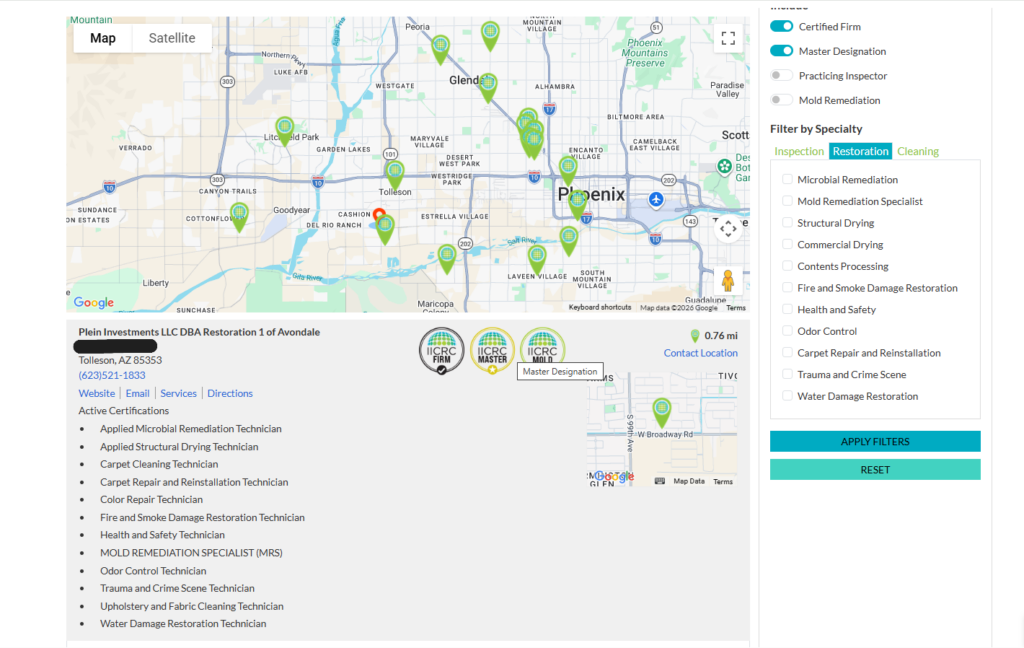
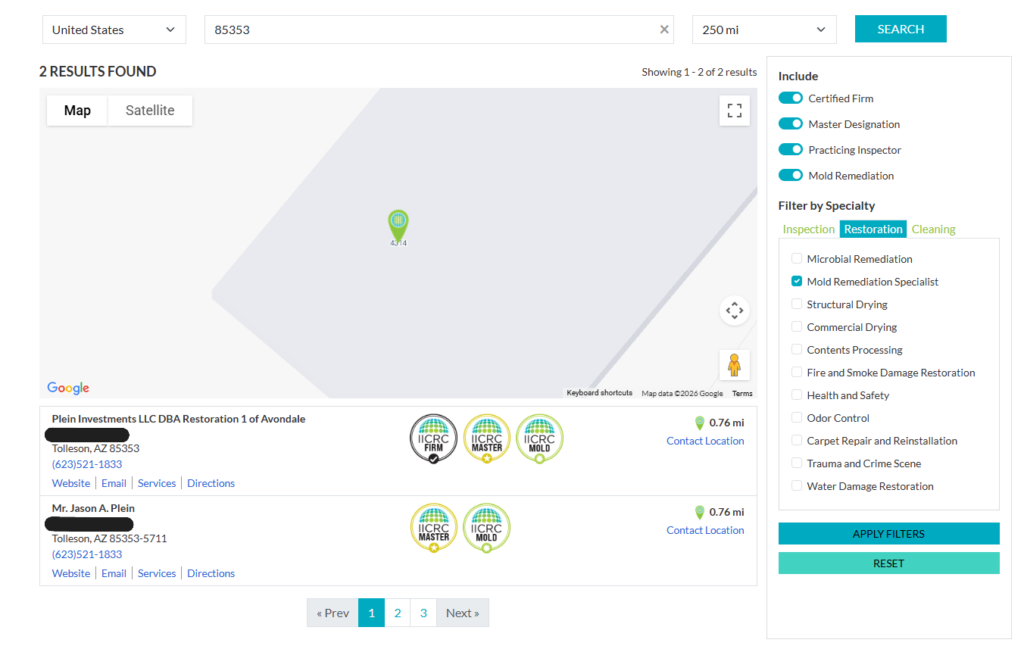
The IICRC Global Locator is the most reliable way to confirm whether a contractor or technician holds active IICRC certifications.

How to Check a Contractor’s Credentials
- – Search the company or technician name. Or simply enter your zip code, a radius and the service you need to list all.
- – Open the business or personal listing.
- – Click the “Services” tab under their business profile.
- – Confirm they hold active certifications for the specific work they are performing.
A company may be listed as an IICRC Certified Firm, but that does not mean they are certified for all services. You must verify the individual certifications tied to the services they offer
Minimum vs. Preferred Certifications
Water Damage Work
Minimum:
WRT (Water Damage Restoration Technician)
ASD (Applied Structural Drying)
Preferred:
Master Water Restorer designation
A contractor performing water mitigation without WRT and ASD is not qualified under industry standards.
Mold Remediation Work
Minimum:
AMRT (Applied Microbial Remediation Technician)- Mold Basic Training
Preferred:
MRS (Mold Remediation Specialist) – Advanced Certification
Why Active Certification Matters
Some contractors were certified years ago but allowed their credentials to expire.
Expired certifications mean:
- – They are not current on ANSI/IICRC S520
- – They have not completed required Continuing Education Credits (CECs)
- – They may be using outdated or unsafe practices
- – They cannot legally claim to be “IICRC certified”
The restoration industry evolves constantly.
Active certification ensures the contractor is up to date on:
- – Standard changes
- – New remediation procedures
- – Updated engineering controls
- – Modern containment and cleaning methods
2. Verify NORMI Certifications by Phone
NORMI does not maintain an easily searchable public online database.
To verify a contractor’s NORMI credentials:
Call NORMI directly at 877‑252‑2296
Ask them to confirm:
- – Whether the contractor is actively certified
- – Which certifications they hold (CMA, CMR, NCRSI, etc.)
- – Whether those certifications are current or expired
NORMI certifications also require continuing education.
If a contractor allowed their NORMI credentials to lapse, they may not be current on:
- – NORMI Professional Practices
- – Updated remediation procedures
- – Health‑sensitive cleaning protocols
- – Moisture diagnostics and building‑science updates
For medically sensitive clients, this distinction is critical.
3. Confirm They Follow ANSI/IICRC S520 and NORMI Professional Practices
A qualified contractor should be able to clearly explain:
- – How they apply ANSI/IICRC S520 (the national standard for mold remediation)
- – How they incorporate NORMI Professional Practices
- – How they manage containment, pressure control, and engineering controls
- – Why source removal—not fogging—is the foundation of proper remediation
If they cannot explain these standards, they are not operating at a professional level.
4. Evaluate Their Containment and Engineering Controls
Proper containment should include:
- – 6 mil poly barriers
- – Fully sealed work zones
- – HEPA‑filtered negative air machines vented to the exterior (if reasonable)
- – Pressure monitoring throughout the project
If a contractor cannot describe how containment is built and maintained, that is a red flag.
5. Require Independent Clearance Testing
Clearance Testing should always be performed by a third‑party Indoor Environmental Professional (IEP)—never the remediation company.
This ensures unbiased verification of the work.
6. Review Their Documentation Practices
A qualified contractor should provide:
- – Photos
- – Moisture readings (when applicable)
- – Containment diagrams
- – Final reports
If they cannot document their work, they cannot prove it was done correctly.
7. Look for Owner‑Operator Oversight
In an unregulated state, oversight matters.
Involved Owner‑operators with advanced certifications provide:
- – Higher accountability
- – Consistent standards
- – Better quality control
- – Direct communication
This is especially important for medically sensitive clients.
Final Guidance
In an unregulated state like Arizona, verifying a contractor’s credentials is essential.
Always confirm
- – Active IICRC certifications through the Global Locator
- – Active NORMI certifications by calling NORMI
- – Compliance with ANSI/IICRC S520 and NORMI Professional Practices
- – Proper containment, documentation, and independent clearance testing